Abstract
Thailand’s extensive coastline along the Andaman Sea and the Gulf of Thailand is vital to its economy and maritime security. Given that wave height is a critical parameter for fishing, tourism, and maritime logistics, extreme wave events pose significant risks to lives and infrastructure. Consequently, accurate forecasting is essential for disaster mitigation and operational planning.
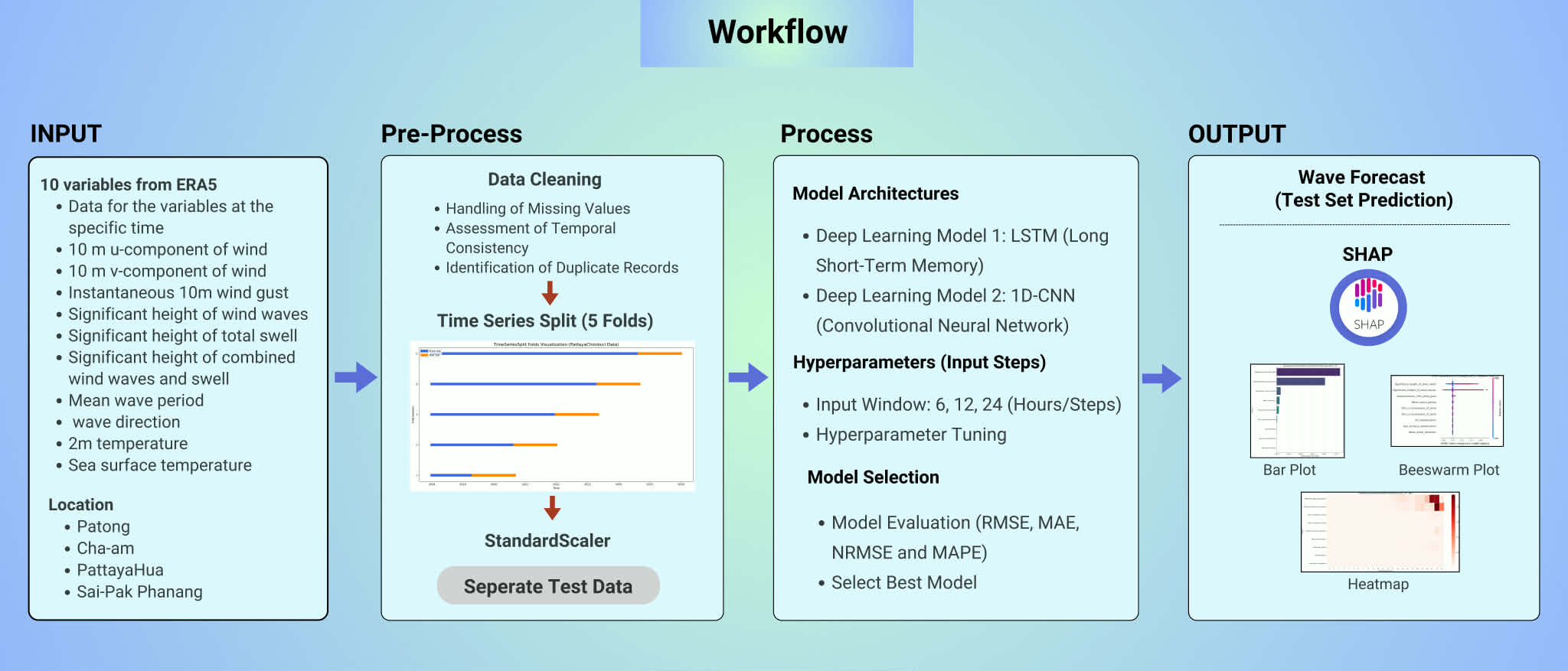
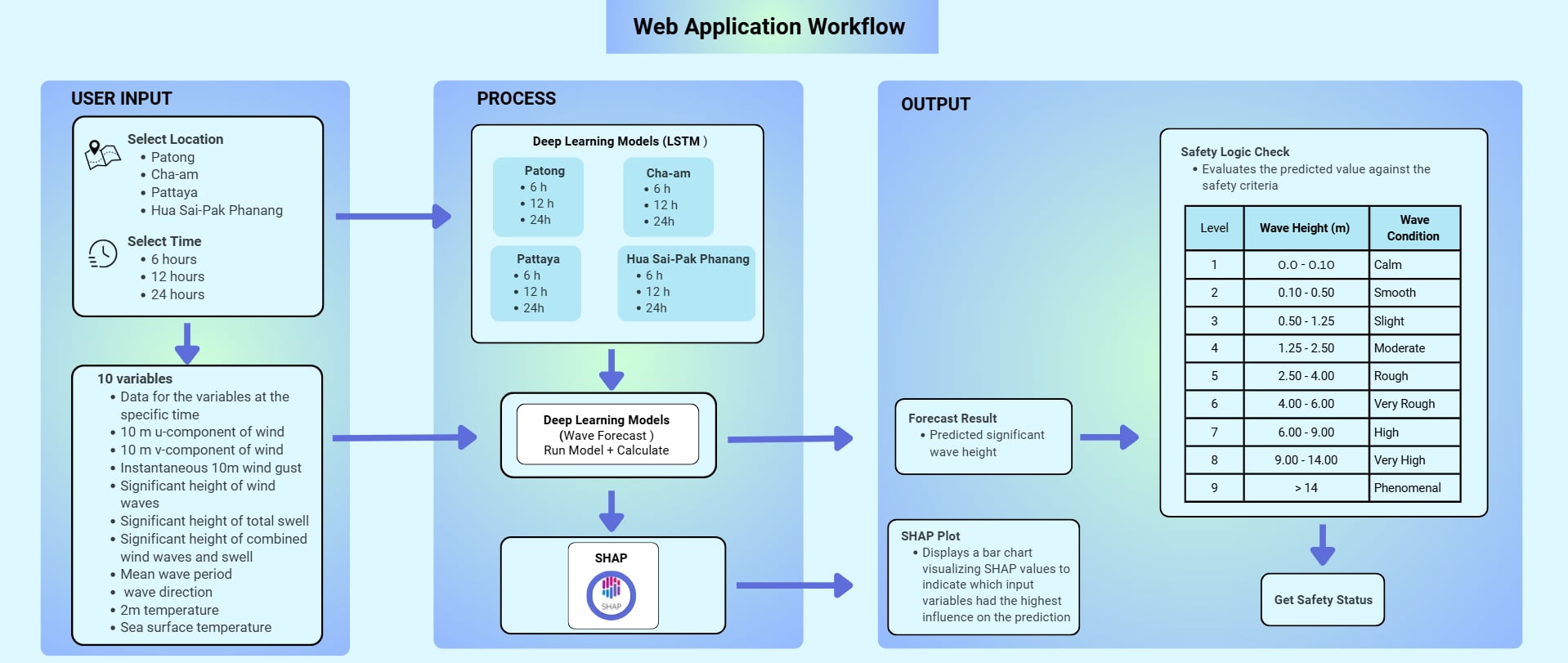
This study develops short-to-long-term wave height forecasting models (6, 12, and 24-hour lead times) by leveraging deep learning techniques, specifically Long Short-Term Memory (LSTM) and one-dimensional Convolutional Neural Networks (1D CNN). The models utilize hourly ERA5 reanalysis data from the ECMWF spanning January 2018 to January 2026.
The research focuses on five strategic coastal locations: Patong Beach (Phuket), Pak Phanang and Hua Sai (Nakhon Si Thammarat), Cha-am (Phetchaburi) and Pattaya (Chonburi). Model performance is evaluated using MAE, RMSE, NRMSE and MAPE. Furthermore, the SHAP (SHapley Additive exPlanations) technique is employed to interpret variable contributions and identify key drivers in the forecasting process.
Keywords: Wave height forecasting, Deep learning, LSTM, 1D CNN, ERA5, SHAP
Main Content

Report
Download Full Project Report

Wave Prediction App
Access the Forecasting Application

Source Code
View Repository on GitHub
Team Members

Student
Kanyawee Khamudom

Student
Natthaphon Artkaeo

Project Advisor
Pitchaya Wiratchotisatian, Ph.D.